
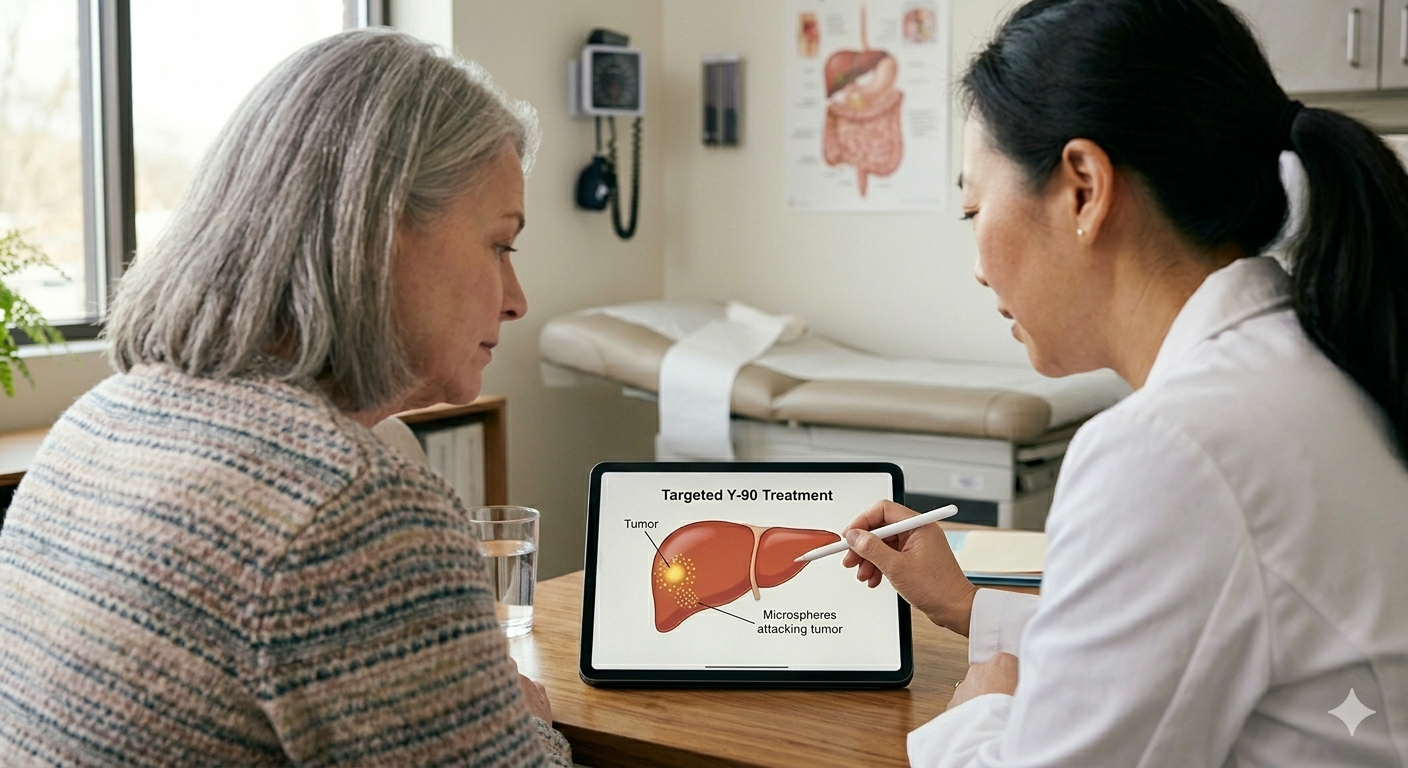



Your care team will determine how Y-90 fits into your overall treatment plan.
Meeting the right specialist: the interventional radiologist
Y-90 is performed by a specialist called an interventional radiologist. These doctors are experts in using imaging (like X-rays) to guide treatments inside the body without traditional surgery.
If Y-90 is being considered, you will typically meet with an interventional radiologist who will:
- Review your medical history and imaging
- Work with your broader care team (oncologists, hepatologists, surgeons)
- Explain whether Y-90 should be considered as part of your treatment plan

Meeting the right specialist: the interventional radiologist
Y-90 is performed by a specialist called an interventional radiologist. These doctors are experts in using imaging (like X-rays) to guide treatments inside the body without traditional surgery.
If Y-90 is being considered, you will typically meet with an interventional radiologist who will:
- Review your medical history and imaging
- Work with your broader care team (oncologists, hepatologists, surgeons)
- Explain whether Y-90 should be considered as part of your treatment plan
How doctors determine if you’re eligible
Not every patient is a candidate for Y-90. Your doctor will consider several factors, including:

The size, number and location of tumors

Whether the cancer is limited to the liver

Your liver function

Your overall health
Blood flow patterns in your liver
Imaging tests (like CT or MRI scans) and lab work will help guide this decision.
The Y-90 treatment process
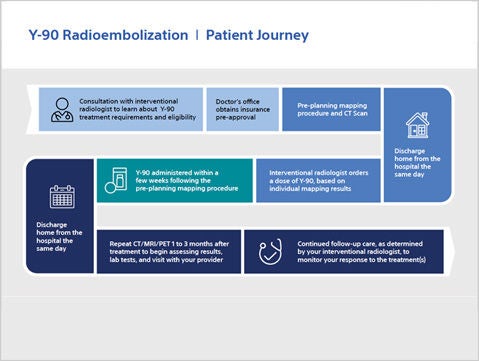
- Step 1: The mapping procedure
- Step 2: The Y-90 treatment procedure
- Moving forward

Before treatment, you will undergo a planning step called a mapping procedure.
During mapping:
- A small catheter (thin tube) is inserted, usually through an artery in the groin or wrist
- The doctor maps the blood vessels that supply your liver
- A small amount of a test substance is injected to ensure the treatment will go to the right place
This step helps your doctor:
- Plan the safest and most effective treatment approach
- Prevent radiation from reaching other parts of the body

The actual Y-90 treatment is typically performed as an outpatient procedure.
During the procedure:
- A catheter is inserted into an artery (similar to the mapping procedure)
- Using live imaging, the doctor guides the catheter to the artery supplying the tumor
- The Y-90 microspheres are slowly delivered through the catheter
- The catheter is removed, and a small bandage is placed
The procedure usually takes
1-2 hours
and most patients go home the same day.
What to expect before, during, and after treatment
Before treatment
- You may need blood tests and imaging
- Your doctor will review medications and provide instructions (such as fasting)
- You’ll discuss what to expect and ask any questions
- You will have a mapping procedure to help the doctor carefully plan where the radiation will go and to ensure it is delivered safely to the tumor
During treatment
- You’ll be awake but may receive medication to help you relax
- Most patients feel little to no pain
- You’ll be monitored closely throughout the procedure
After treatment
- You’ll rest for a few hours before going home
- Mild side effects are common and may include:
- Fatigue
- Nausea
- Low-grade fever
- Abdominal discomfort
These symptoms usually resolve within a few days. Consult your doctor if you have any side effects.

Y-90 radioembolization is an important option for many people with liver cancer.
Whether it’s used to control disease, make other treatments possible, or potentially eliminate tumors, it offers a targeted, minimally invasive approach.
If you’re exploring treatment options, asking to speak with an interventional radiologist can be an important next step in understanding what’s possible for you.
Every patient’s situation is unique. Be sure to talk with your care team about what treatment approach is right for you.

After treatment, your doctor will schedule follow-up visits to monitor your progress.
This typically includes:
- Imaging scans (CT or MRI) to see how the tumor responded to the Y-90 radiation
- Blood tests to assess liver function
- Discussions about next steps in your care
It can take weeks to months to fully understand how well the treatment worked, as the radiation continues to act over time.
Important Safety Information for TheraSphere
TheraSphere Microspheres are small radioactive glass beads that treat liver cancer. With all medical procedures, there are risks associated with the procedure and the use of the device. Although the radioactivity continues to go down over time, the glass beads will remain permanently in your liver. The risks include but are not limited to: • Bleeding from the stomach or intestines • Fatigue (feeling very tired) • Fever • Infection • Loss of appetite • Mild abdominal discomfort • Nausea • Radiation damage to other locations (including but not limited to lungs, gallbladder, stomach, intestines) • Stomach or intestinal ulcer • Temporary changes in liver and blood tests • Vomiting Rarely the treatment may cause worsening of your liver function that could lead to liver failure and death. Tell your doctor if side effects continue or get worse. Be aware that some side effects may last longer or, rarely, become permanent. Everyone responds differently to their treatment. These are not all the possible side effects you may feel. Contact your doctor if you experience any side effects. Be sure to talk with your doctor so that you thoroughly understand all of the risks and benefits associated with the use of the device. 97574929B